You ask Google in AI Mode: "which insulated water bottle should I buy for hiking, under 40 euros?". The answer comes back with three models, their photos and a link to each store. You sell the same bottle, but your store is nowhere to be seen.
Budget has nothing to do with it: these spots cannot be bought. They depend on what the AI knows about your products, and on who talks about them. We show you where it looks for that information, and how to hand it over.
- Generative engine optimization (GEO) means getting AI assistants such as ChatGPT, Gemini and Perplexity to cite and recommend your products.
- Product recommendations in these assistants cannot be bought: ads, where they exist, are handled separately.
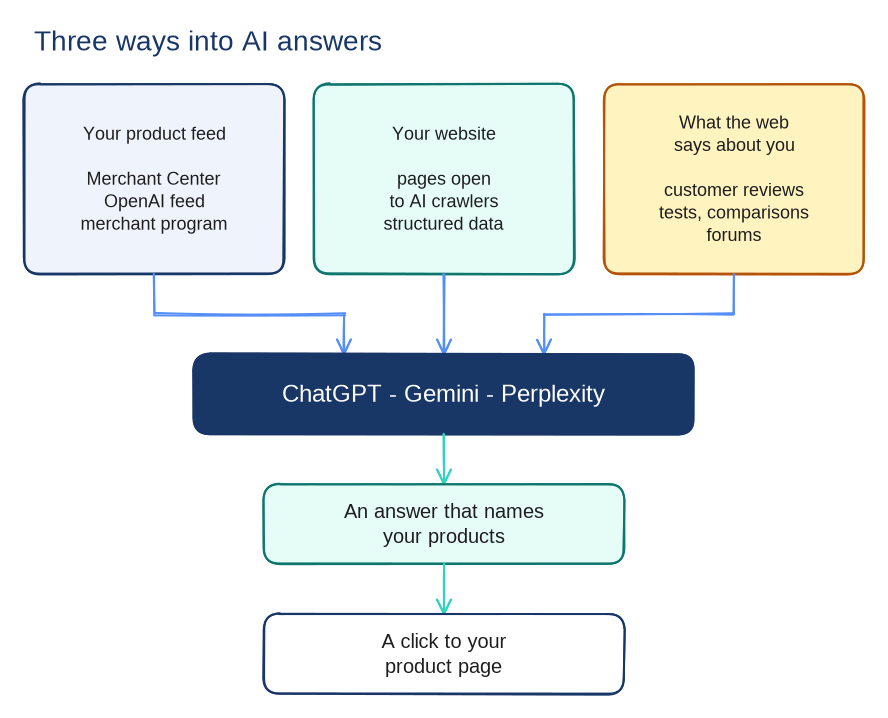
- Three ways in: your product feed (Merchant Center for Google, a merchant feed for ChatGPT), a website open to their crawlers, and what the web says about you (reviews, tests, comparisons).
- The most underrated lever: product pages that answer precise questions (use, capacity, material, compatibility).
- You can measure it: the generative AI data in Search Console, and
utm_source=chatgpt.comin your analytics.
GEO, AI search, SEO: what are we talking about?
SEO aims for a spot in a list of links. Generative engine optimization aims for a spot inside the answer itself: the assistant reads several sources, writes a summary, and only names a handful of products.
The two are not at odds. Google says it plainly in its documentation: optimizing for its generative AI features is still SEO, and there are no extra requirements to appear in AI Overviews or AI Mode. A page that crawlers cannot read, or that describes the product poorly, stands no better chance with an AI than with Google.
What changes for a store is the shape of the request. Nobody types "stainless bottle 750" into ChatGPT. People describe a need, with a budget and constraints, and the AI looks for products whose data answers each one.
This article is about visibility: being recommended by an assistant. The protocols that let an agent buy on the customer's behalf (UCP, ACP, AP2) are a different topic, covered in our article on agentic commerce and its protocols.
Where assistants find your products
Here is what a product answer looks like in Google's AI Mode.
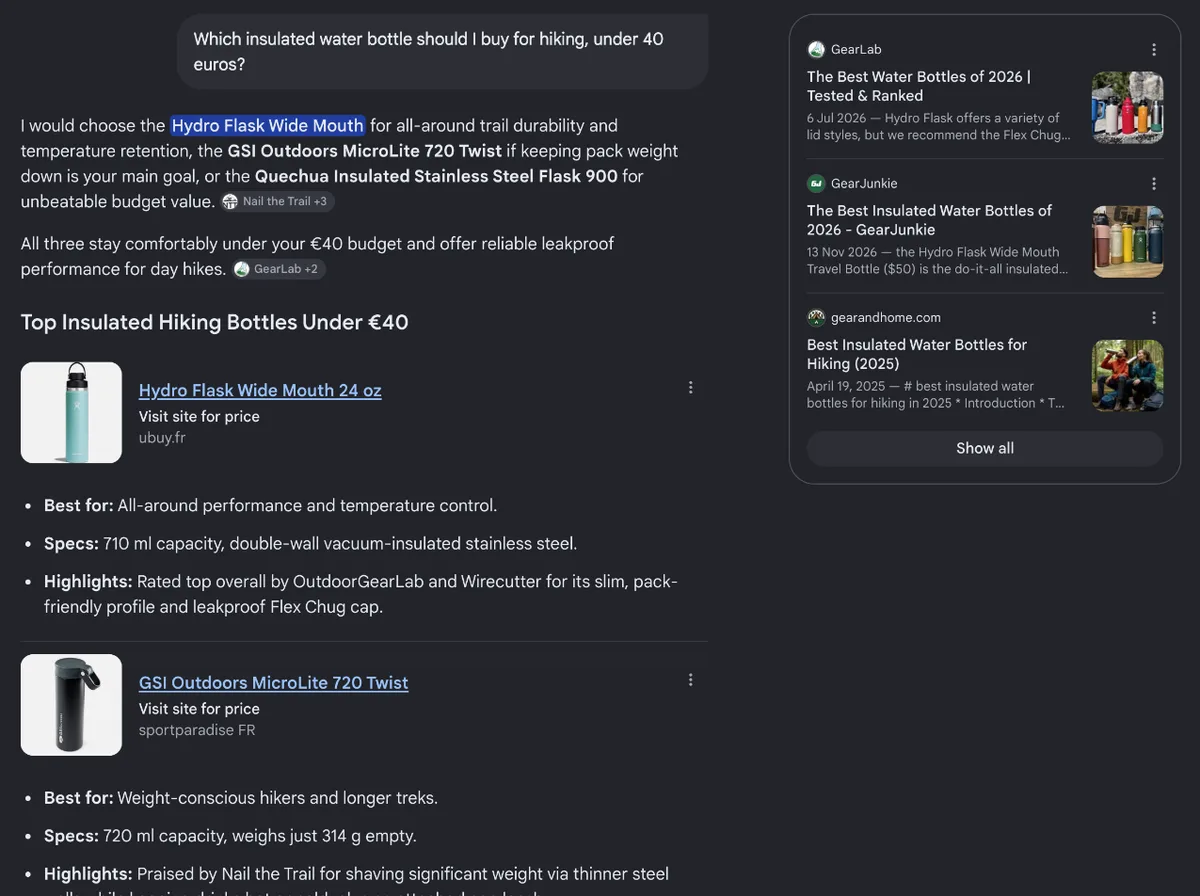
Look at the right-hand column: the answer draws on tests and guides published outside the merchant's site. And each product card links to a specific store. These two elements come from different sources, and you find the same pattern with all three assistants.
| ChatGPT | Gemini and Google AI Mode | Perplexity | |
|---|---|---|---|
| Product data | Merchant feed on application; Shopify and Etsy included automatically | Merchant Center feed (free listings) | Merchant program for large retailers; Shopify integration |
| Crawler to allow | OAI-SearchBot | Googlebot | PerplexityBot |
| Built-in shopping | Live for US users, more regions announced | AI Mode and AI Overviews widely available, including in Europe | PayPal checkout for US users |
| Paid results? | No, ads are separate | Free listings, ads handled separately | No, according to Perplexity |
In practice, if you sell outside the US, Google is the most open door today, and it goes through a tool you may already use: Merchant Center. ChatGPT and Perplexity already cite web pages in their answers, but their feed-powered product carousels are opening in the US first.
Step 1: let AI crawlers in
This is the simplest prerequisite, and the one people forget. Each assistant crawls the web with its own bot, and each one is controlled from your robots.txt file.
- OAI-SearchBot: OpenAI states that a site that blocks it is not shown in ChatGPT's search answers (it can only appear as a plain navigational link).
- PerplexityBot: Perplexity recommends allowing it to appear in its results.
- Googlebot: the same one as for classic SEO. AI Overviews and AI Mode draw on Google's index.
You can refuse model training without losing visibility. At OpenAI, each bot is set independently: GPTBot is used for training, OAI-SearchBot for search.
robots.txt is not the only filter. Google recommends also checking your CDN or hosting settings: a firewall that blocks AI crawlers makes your store invisible, even with a perfect file. And on Google's side, the Google-Extended token does not remove your pages from Search, but it also covers grounding in the Gemini app's answers: think twice before blocking it.
Step 2: polish your Merchant Center feed for Gemini
On Google's side, everything starts with the feed. Its generative AI documentation says so explicitly: Merchant Center feeds help your products be visible in AI responses as well as in the rest of Search. And the free listings page names Gemini among the places your products can appear.
If your free listings are active, you are already eligible. No account yet? Our Merchant Center tutorial starts from scratch, and our article on Google Shopping free listings shows how to turn them on.
Conversational attributes, built for AI Mode
Google recently added six optional attributes to the feed specification, designed to help AI systems understand the nuances of your products. They have no effect on the approval of your existing products.
question_and_answer: frequently asked questions about the product, with their answers;document_link: links to PDFs (manual, assembly guide, size chart);related_product: related products (accessory, compatible part, alternative);item_group_titleandvariant_option: the name of a variant family and what sets each variant apart (size, color);popularity_rank: how popular the product is within your catalog, as a percentage.
Google advises adding them through a supplemental data source, without touching your primary feed, and not repeating what the description or product_detail already says.
An outdoor store with 600 products starts with its 40 best sellers. For each one, it pulls the three questions customer service hears most ("is it dishwasher safe?", "does it fit a backpack's bottle pocket?") and sends them as question_and_answer. That is 40 × 3 = 120 pairs to write, one day of work, on the products that matter most.
Step 3: get into ChatGPT Shopping
ChatGPT's product results rely on structured metadata supplied by merchants and third-party providers. OpenAI states that they are not ads, and that purchases are completed on the merchant's website or app: buying directly inside ChatGPT has been set aside in favor of discovery.
Your route depends on your platform:
- Shopify: your products are integrated through Shopify Catalog, with nothing to do on your side.
- Etsy: the same applies to sellers on the platform.
- WooCommerce, Magento, PrestaShop and others: apply through the form on ChatGPT's merchants page, then send a feed that follows OpenAI's specification. Applicants go on a waitlist, and OpenAI has announced a self-serve portal.
OpenAI's feed looks a lot like Google's. The required fields are item_id, title, description, url, brand, seller_name, image_url, availability and price, plus the target countries. Recommended fields include gtin, color, size, material, the return policy, the review count and the average rating. A clean Merchant Center catalog is therefore largely ready for ChatGPT, and a product feed management tool can handle the conversion.
OpenAI says shopping in ChatGPT is currently live for US users, with other regions to follow. If you sell mainly outside the US, apply to get in line, but don't build your plan around it: step 1 (crawlers) and step 5 (listings) already make you citable in ChatGPT's web answers.
Step 4: Perplexity, a special case
Perplexity shows product cards in its answers and, since November 2025, lets US users pay with PayPal without leaving the conversation. The merchant remains the seller: it keeps the customer relationship, returns and after-sales.
Its free merchant program is explicitly aimed at large retailers, who share their product specs to be better indexed. For a smaller store, the realistic lever lies elsewhere: allow PerplexityBot, keep product pages complete, and get cited by the sites Perplexity reads.
Step 5: write listings that answer questions
An assistant breaks the customer's request into criteria, then looks for products that meet them in black and white. A page that only says "elegant, practical insulated bottle" answers none of them.
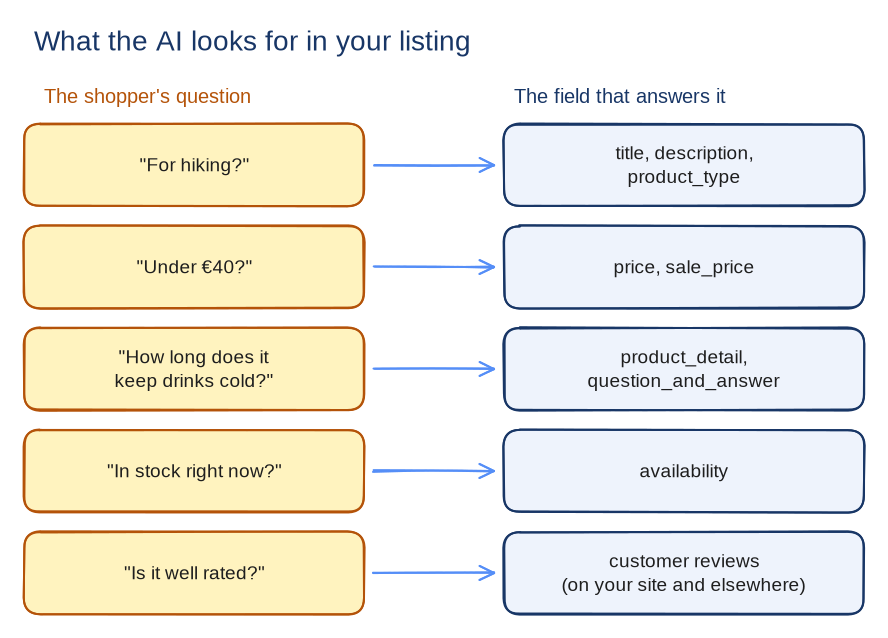
Start from real questions. Your customer service, your reviews and the queries typed into your site search give you the exact list of what shoppers want to know.
In the description, give verifiable facts rather than adjectives: hours of cold and heat retention, empty weight, dishwasher compatibility, dimensions. These are what the AI quotes in its answer, as in the screenshot above.
- Numbers: capacity, weight, hours, dimensions
- The use case in the title (hiking, office, kids)
- Product structured data that matches the visible text
- The same price and stock everywhere
- "Premium quality", "unique design"
- The manufacturer's description pasted as is
- Key information hidden in an image
- A feed that lags behind your site's prices
Step 6: get talked about elsewhere
The AI Mode screenshot makes it clear: the sources cited are tests, buying guides and comparisons. On ChatGPT's side, OpenAI says review summaries draw on public websites. What others say about your products weighs as much as what you say yourself.
- Collect reviews on your product pages and on a recognized review platform. At Google, you generally need at least 100 eligible reviews to get a store rating.
- Send your flagship products to the blogs and media that publish comparisons in your niche.
- Answer where your customers ask questions: specialist forums and community groups, without disguised advertising.
Ask ChatGPT, Gemini and Perplexity the five questions your customers ask most, and write down the sites cited in the answers. That list is your PR plan: these are the sources AI assistants already read in your market.
Measure what AI assistants send you
You don't need a paid tool to get started. Three free sources cover the essentials:
- Search Console: clicks from AI Overviews and AI Mode are counted in the Performance report, under the "Web" search type. Since late summer 2026, Search Console also shows every site dedicated data: which pages appear in AI answers, and in which countries.
- Google Analytics: ChatGPT automatically adds
utm_source=chatgpt.comto the links in its answers. Filter your sessions on that source, and check Perplexity and Gemini in your referrals too. - Merchant Center: Google is preparing a performance report for AI surfaces (AI Mode, AI Overviews, the Gemini app), announced first for the US, Canada, Australia, India and New Zealand.
Over 30 days, the outdoor store records 150 sessions with utm_source=chatgpt.com and 6 orders: 6 ÷ 150 = 4% conversion rate. The volume is modest, but the landing pages tell the story: 90 of those sessions land on two bottles, the ones whose page states how long they keep drinks cold. That is the format to roll out across the range.
What doesn't help (for now)
The topic attracts a lot of offers. Before you sign anything, keep in mind what the platforms themselves say.
- An llms.txt file: Google states that no special file, markup or format is needed to appear in its search. Creating one does no harm, and it won't work miracles.
- Chopping your pages into small chunks "for AI": Google says this is not necessary. Write for your customers.
- "AI-specific" schema.org markup: there is no such thing. Product structured data remains useful, for rich results.
- Promises of "ranking first in ChatGPT": nobody has access to the assistants' rankings, and their answers vary from one conversation to the next. Google also warns against third-party tools that claim to read its internal metrics.
And once the visitor lands on your site?
Let's be clear from the start: Vectail does not get your products into ChatGPT, Gemini or Perplexity, and has no integration with these assistants. Its job is your store's own site search.
But the connection with everything above is direct. A visitor sent by an AI has already put their need into full sentences. If they don't land on the right model, they say it again to your search bar, in the same words: "light kids' bottle that keeps water cold". This is exactly where many search engines fall short.
Vectail imports your catalog from Merchant Center, with the titles and attributes you have just enriched for AI assistants, and puts them to work in a search engine that understands this kind of sentence. The work done to get cited outside also helps you sell inside. The details are in our article on the Merchant Center feed as the foundation of site search.
Your checklist
OAI-SearchBot,PerplexityBotandGooglebotallowed in robots.txt and by your CDN- Free listings active in Merchant Center, with no disapproved best sellers
- Conversational attributes added to your top 20 to 50 products, through a supplemental source
- Shopify or Etsy: nothing to do for ChatGPT; other platforms: application submitted
- Titles rewritten: product type, use case, capacity
- Descriptions with numbers: hours, weight, dimensions, compatibility
- Reviews collected on your site and on a recognized platform
- List of sites cited by AI assistants in your market, and first outreach done
utm_source=chatgpt.comsegment created in your analytics, reviewed monthly
Frequently asked questions
Can you pay to appear in ChatGPT's answers?
Not in product results: OpenAI states that they are not ads. Ads in ChatGPT exist, but they are handled separately. Perplexity says the same about its product cards. Organic visibility comes from your data and your reputation.
Does generative engine optimization replace SEO?
No, it builds on it. Google says its AI features rely on the same foundations as classic search, and ChatGPT and Perplexity crawl the web with their own bots. A page Google cannot find is unlikely to be cited by an AI assistant.
Should my store create an llms.txt file?
It is not a priority. Google states that no special file is needed to appear in its AI features. Your time is better spent on your product feed, crawler access and the quality of your product pages.
Your listings are ready for AI? Put them to work on your own site
Vectail imports your catalog from Google Merchant Center and adds a search engine powered by Google Vertex AI to your store: natural language understanding, typo tolerance, results as you type. One line of code, no plugin.
Start for free - 14-day free trial, no credit card