Over the past year, Google, OpenAI, Shopify, Visa and Mastercard have released one protocol after another, with names like UCP, AP2 and ACP. They all aim at the same thing: letting an AI assistant search, compare and sometimes buy a product on behalf of its user. This is what people call agentic commerce.
For a merchant, the question is not whether shopping agents are a good idea, but how they change the way products get found. This article reviews the protocols in play, what is actually available today, and what it means for your product data and your site search.
What a shopping agent actually does
Take a request like "find me a lightweight rain jacket for hiking, under €150, delivered before Saturday". An agent does not type two words into your search bar and then scroll a results page. It queries structured catalogs, filters on price, availability and delivery time, compares a few products and presents a short selection, explaining its choices.
Depending on how much autonomy it is given, the agent works at three levels.
Recommending
The agent suggests products and links to the merchant's site, where the purchase happens as usual. This already happens today in ChatGPT, Gemini and Google Search's AI Mode, in most markets.
Building the cart
The agent puts together a cart, possibly across several merchants. The shopper approves it, then pays on the merchant's site or through a payment built into the assistant.
Buying on the shopper's behalf
The agent pays itself, within limits set by the shopper: budget, brand, delivery time. This is the level that raises the real questions of trust, fraud and liability, and it is the one payment protocols are trying to frame.
The protocols in play
For an agent to talk to thousands of stores without a custom integration for each, common standards are needed. Three are worth knowing.
UCP, Universal Commerce Protocol (Google)
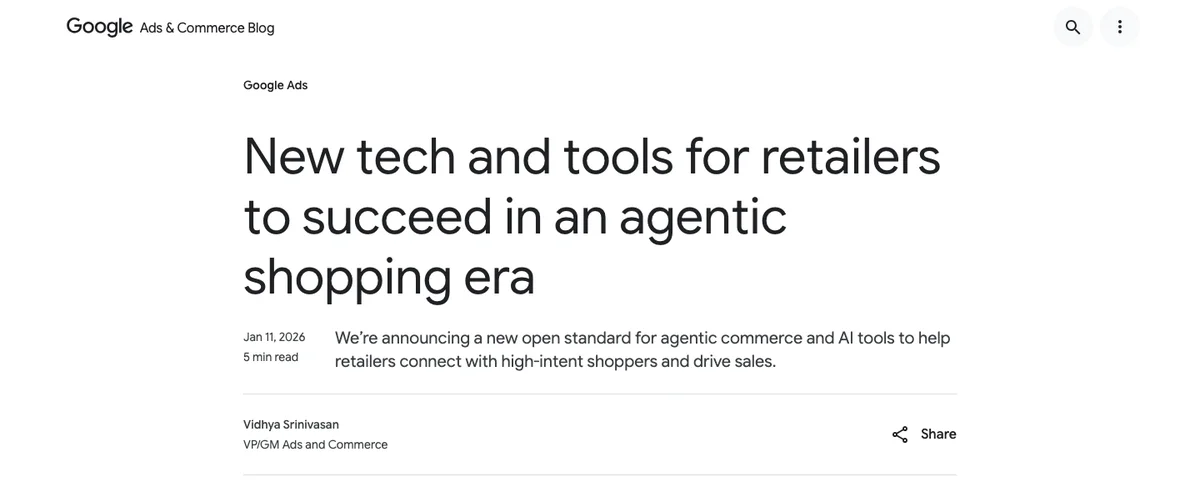
Announced on January 11, 2026 and co-developed with Shopify, Etsy, Wayfair, Target and Walmart. UCP covers the whole journey: discovery, checkout and post-purchase. It is compatible with AP2 as well as MCP and A2A, the protocols that let agents call tools and talk to each other. The merchant remains the seller of record. In March 2026, Google added a multi-item cart, real-time access to the merchant's catalog (variants, inventory, pricing) and identity linking, so shoppers keep their loyalty benefits. Integration goes through Google Merchant Center.
AP2, Agent Payments Protocol (Google)
Introduced in September 2025, AP2 deals with payment only. It relies on signed "mandates": verifiable proof that the shopper authorized a given purchase, within given limits. Card networks are moving in parallel with their own schemes for agent-initiated payments, Visa Intelligent Commerce and Mastercard Agent Pay.
ACP, Agentic Commerce Protocol (OpenAI and Stripe)
Launched in September 2025 together with Instant Checkout, payment directly inside ChatGPT, first in the United States. In March 2026, OpenAI changed course: merchants keep their own checkout, and ACP is mainly used to send catalogs and promotions for product discovery in ChatGPT.
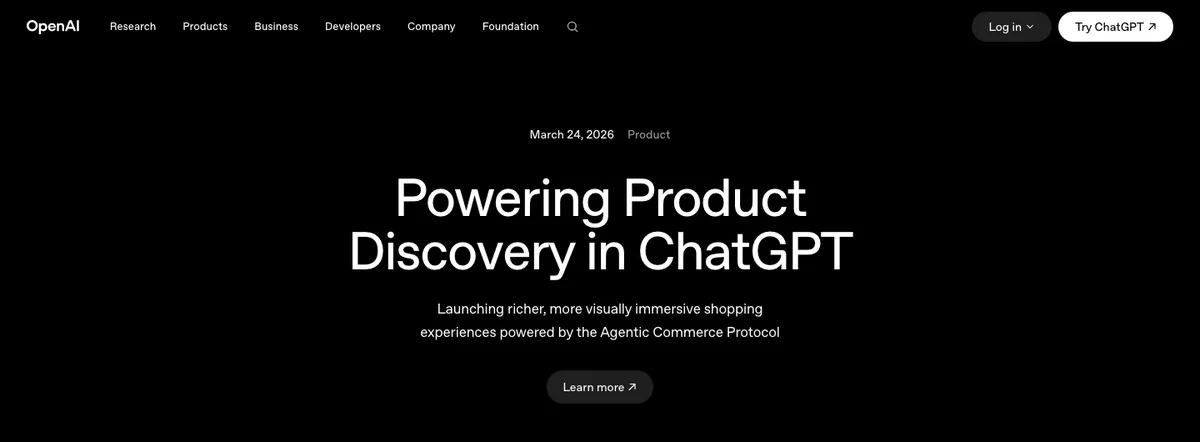
OpenAI's U-turn is telling. Getting users to pay inside the assistant proved harder than expected, and the market is settling on a more modest model: the agent discovers and recommends, the merchant sells.
What is available today
On the payment side, availability is narrow. Checkout inside AI Mode and Gemini, like Google's Universal Cart presented at Google I/O in May 2026, is rolling out in the United States first. Instant Checkout stayed limited to the US market before being scaled back.
Discovery, on the other hand, is already here in most markets. ChatGPT, Gemini and AI Mode recommend products and send shoppers to merchant sites. In March 2026, Carrefour became one of the first European retailers to offer its products in ChatGPT: shoppers build their basket there, then complete the order on the retailer's own site.
What it changes for product search
The query becomes a description. An agent works from a need expressed in natural language, which it translates into criteria: use, budget, size, delivery time. A shopper used to describing their needs to an assistant has little reason to go back to two-word queries on your site. An engine that only understands exact keywords will disappoint them, where semantic search can interpret the request.
Structured data becomes the shop window. An agent sees neither your layout, nor your banners, nor your lifestyle photos. It sees attributes: title, price, availability, color, size, material, compatibility. In January 2026 Google announced new Merchant Center attributes designed for conversational surfaces: answers to common product questions, compatible accessories, substitutes. A poorly described product does not get recommended, however good its product page looks.
Real time becomes a requirement. An agent that recommends an out-of-stock product, or one whose price has changed, loses its user's trust. That is the whole point of the real-time catalog access added to UCP. Fresh inventory and pricing, already important for site search, now decide whether a product gets suggested at all.
Search on your own site does not go away. The most common journey today is still "discover in the assistant, buy on the site". A visitor arriving from an agent has often already narrowed down their need: they land on a product page, compare variants, look for an accessory or another size. If they cannot find it, they go back to the assistant, which will suggest a competitor.
The Merchant Center feed, the common entry point
At Google, everything converges on Merchant Center: UCP is activated from Merchant Center, the new conversational attributes are added to the product feed, and the shipping and return policies declared there feed into comparisons. At OpenAI, discovery also relies on a catalog feed sent through ACP.
That feed already powers Google Shopping, and it can power your site search too, as we explain in our article on Merchant Center and site search. Quality work on the feed therefore pays off in three places: ads, AI agents and search on your own site.
What to do now
There is no need to start a UCP or ACP integration project until agent payments are open in your market. The useful actions lie elsewhere, and they pay off today.
1. Audit your Merchant Center feed. Titles, descriptions, product_type, variant grouping: the checklist in our Merchant Center article applies as it is.
2. Fill in the choice attributes. Color, size, material, use, compatibility: these are the criteria an agent filters on. Our guide to product data quality covers the most common mistakes.
3. Make inventory and pricing reliable. Align how often the feed is updated with how often things actually change.
4. Declare shipping and returns. Agents compare terms of sale too. Set them in Merchant Center rather than leaving them buried in your terms and conditions.
5. Take care of the welcome on your site. Search that understands natural language, tolerates typos and never returns a zero-results page keeps the visitor an agent sent you.
6. Follow your platform. Shopify, co-author of UCP, integrates these protocols at platform level. On PrestaShop, WooCommerce or Magento, watch announcements from your vendor and your extensions before commissioning custom development.
Your products are well described? Put that to work in your own search
Vectail connects to your Google Merchant Center and adds natural-language search powered by Google Vertex AI to your site. One line of code to install, no plugin.
Start free - 14 days, no credit cardOur position
Vectail does not offer agent payments and is not building them. What interests us in agentic commerce is the direction it confirms: product search increasingly happens in natural language, on structured data. That is exactly what an engine like Google Vertex AI Search for Retail does on your site, from the same Merchant Center feed that Google's agents read.
The dates in this article will age quickly. The work on your product data will be useful whichever protocol wins.